
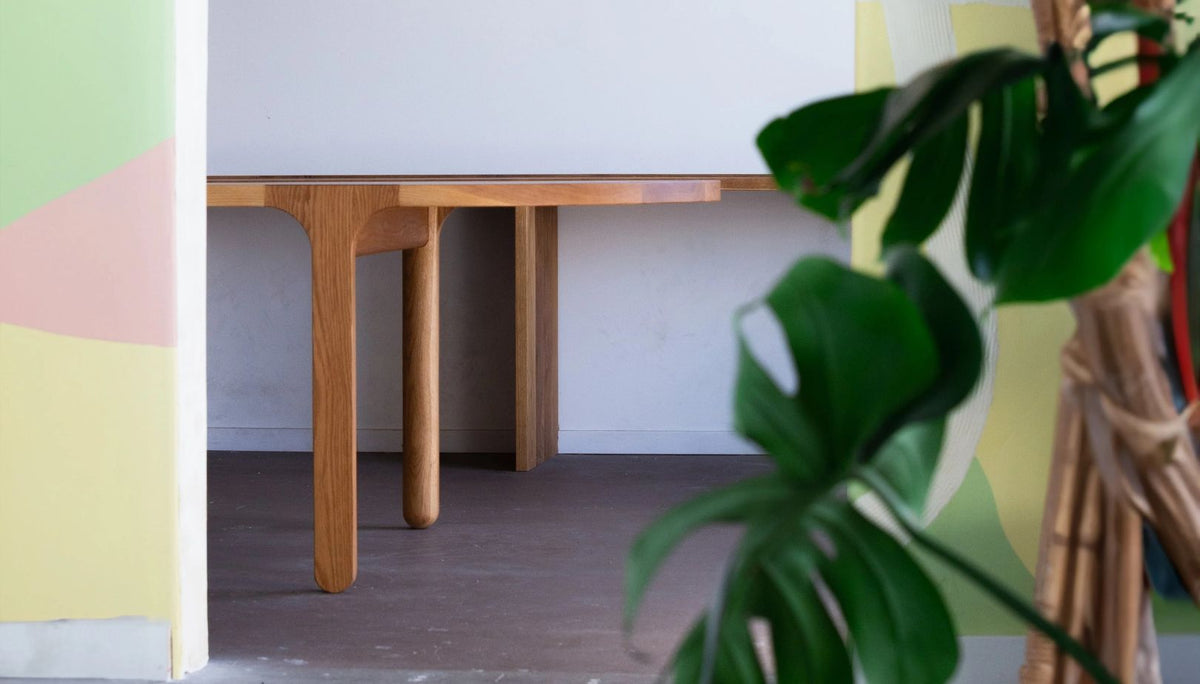
Some of our favorite builds to come through our Santa Cruz workshop are solid dining tables—the type that are built to last as your family grows and changes.
We know the dining table is one of the places at home where you’ll create the most memories, and fostering your connection with others is top of mind when we design and build each piece.
The finished products are expert-crafted tables available in our Santa Cruz studio or ready to ship throughout the U.S., along with made-to-order options with every piece. Learn more about our process and explore the dining tables we craft year-round.
Jump to:
- Selecting and arranging lumber
- The many ways we tread the edge of a dining table
- Home-healthy finishes with hardwax oil
- The Sunday Table
- The Ohana Table
- Finding the right dining table for your home
Selecting and arranging lumber

The first step in creating our dining tables is sourcing, selecting, and arranging lumber to create the most durable and beautiful tabletops. Currently, each of our dining tables is available in White Ash, Walnut, and White Oak, which we source responsibly from domestic forests. This is not your run-of-the-mill Home Depot lumber. Deep relationships with best-in-class vendors mean we get access to some of the best hardwood for each job.
Once we have boards, our team takes the time to arrange and hand-select the best options for color consistency and longevity, paying special attention to the wood grain and lumber quality. We also opt for wide boards, which create a more bespoke feel in each table.
Details matter: The many ways we treat the edge of a dining table
We use thick, solid tabletops, which let us have more fun with the edges. Some ways we like to treat the edges include roundovers, chamfers, or both.
Roundovers give the edges a soft curve, while chamfers add a slant to the edges—both offer more interesting and pleasant edges to interact with than a sharp 90-degree edge. Especially with young children or bigger families, these edge details create a better dining experience overall, as well as hinting at the solid wood construction of the tops.
As with many JOHI pieces, solid wood joinery plays an important structural and aesthetic role in each piece. In the Sunday table, for example, the leg timbers come up through the tabletop, highlighting where and how these components come together, whereas in the Ohana table, all the joinery is hidden within each joint. Both approaches result in a clean, modern style that works well with fresh California coastal, modern organic, and midcentury modern interiors.
Home-healthy finishes with hardwax oil
We always finish our hardwood dining tables with hardwax oil for a natural look and a home-healthy finish. Most commercially sold tables are finished in thicker varnishes and lacquers, which form a very thin film that breaks down over time.
Because dining tables see a ton of use over the years (mealtime, playtime, and more), commercial finishes show high-wear areas, and loose microplastics break down in the worn sections as well. The only way to refinish a film is to sand the entire surface off and start over, which can be costly and wasteful.
Alternatively, we prioritize a finish that is beautiful, non-toxic, easy to maintain, and easier to finish after years of wear. With hardwax oil finishes, you just need a wood cleaner or mild soap that contains a bit of refreshing oil to keep it clean and maintain the protective layer. After a few years, it may just need a new layer of oil, which is easy for you to do at home and doesn’t require professional help.
The Sunday Table

The Sunday Table evokes Scandinavian minimalism, using rounded design elements across the tabletop and the legs. Originally designed by Square Objects for a local cafe near Santa Cruz, we now partner with Square Objects to make the design here at JOHI. It is intentionally designed so many people can sit seamlessly around the table. The pill-shaped ends allow for comfortable sitting without bulky legs or corners getting in the way. In the home, this makes it perfect for everyday use and hosting.
The Ohana Table

The Ohana Table has a rectangular top and elegant, angled legs. It’s a familiar, modern form that uses quality hardwood and intentional joinery, setting it apart from similar commercial options. With this table, we treat the edges with a chamfered (or beveled) top edge and a rounded bottom edge. This combination is a unique touch that is not only beautiful, but comfortable and enjoyable to sit at. This table design also works beautifully across multiple sizes, able to support more petite kitchen & dining spaces, as well as more expansive great rooms.
Finding the right dining table for your home
If you’re looking for a new dining table, first consider your daily use. How many people will be sitting at the table every day? Will you also use the table for playtime with kids? Those types of questions can you help you determine the size and material you need for comfort and durability.
Typical dining tables should be around 30” high, with lengths around 60” to accommodate 4-6 people or 96” and more to seat 8+ people. At JOHI, you can always contact us directly if you’re looking for a custom size.
Next, consider aesthetics. Our solid wood dining table designs are typically a great fit for midcentury modern, Scandinavian, Japandi, California Coastal, and Transitional design styles. Through our woodwork, we emphasize the natural beauty of hardwood and spend time selecting the right boards for each piece for a seamless, cohesive feel.
As you’re looking for the right dining table, don’t hesitate to reach out! We’re always happy to work one-on-one with customers so you can find the perfect fit. You can also visit us in our Santa Cruz showroom and view a variety of our furniture pieces in person to get a better idea of the look and feel.